4. What is thinking and learning?
Introduction
To review, I am practicing using research models as lenses on everyday experiences in my work here. My goals:
Improve my ability to use research models in real time, while reflecting and during collaboration
Enhance my ability to help others see why this is valuable
I believe there are significant advantages gained from this practice:
I am comparing my anecdotal experiences to models grounded in larger sample sizes.
Researcher models have specific identifiable parts. These parts make the iterative process of learning less random.
While I continue to spotlight System Thinking’s DSRP Theory in this post (Cabrera & Cabrera), I will also sow in another theory in my updates section. When the work here has established stronger roots, I’ll map out the small ecosystem of validated theories I use daily (though at times still somewhat clumsily).
In Post 4, I’m going to adapt my format. I’m weaving the DSRP study into the real world example. The discussion will be in the map captions. If you’d like to read through the real world example to get a sense of the story before engaging with the DSRP mechanics in map captions, you might skip over the maps on your first read through.
DSRP Theory spotlights in this study
Cabrera & Cabrera’s DSRP Theory is a Systems Thinking theory supported by a robust and growing body of empirical research. (The concept empirical basically means verifiable by observation.)
Distinctions, Systems, Relationships, Perspectives are four underlying and universal patterns of cognition. Systems thinking is organizing information using these four patterns to make meaning. Each pattern contains two elements.
People use these 4 patterns and elements to organize information whether they know it or not. We become conscious users of DSRP Theory by trying to align both the structure and the information of our mental models with reality. To see the world how it is, not how we wish it to be.
The Distinction pattern is composed of an identity (element), a boundary and other (element)
Most people do not consistently think explicitly about
where an identity ends (its boundary)
A list defining other (increases identity border crispness)
Lists explicitly defining other:
clarifies meaning
reduces confusion from
blurriness created by partially overlapping concepts (language)
outright contradictions obscured by hastiness &/or power imbalances (This is based on my observations, not validated research)
Two cognitive moves we can use to practice distinction making in action are:
Distinction- identity/other Lists (Dio List) aka Is / Is Not Lists
Continuums
Since organizing both what something is and what it is NOT is not a common practice, doing so is an easy way to
improve the accuracy of one’s mental models
improve communication & collaboration
DSRP study grounded in a real world example
By late winter that year, I had been working hard to improve my teaching going on 12 years. My improvement was focused on students being able to transfer their learning to real life experiences. I had plenty of small successes with this approach. But none of these successes quieted my awareness that some students seemed to peak in 9th grade. This awareness was screaming at me. While I was conscious that some of my lessons worked for students, some appeared to work, and some did not work; I had no systematized or fine grain process to distinguish what worked from what didn’t work. I wasn’t even cognizant that I should or could build such a process.
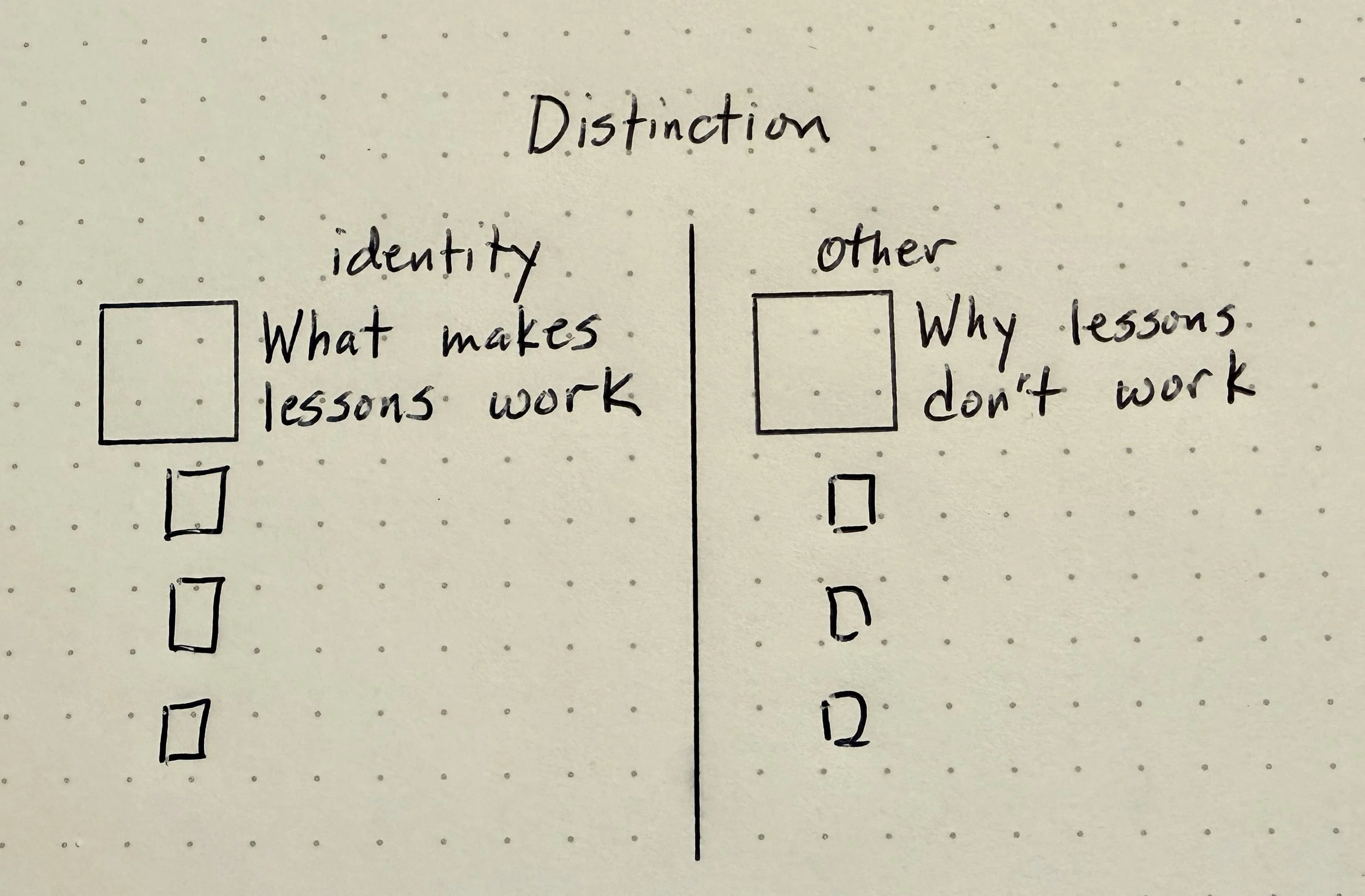
Map 1: Cognitive Move: Distinction identity/other List (Dio List). At the time of this experience, I had an implicit sense I needed this map. While I was as Derek Cabrera describes, “lost in the information,” I was conscious of being lost. Lost in a sea of past practices and best practices both built on assumptions I couldn’t see explicitly enough to interrogate.
As the school days rolled by, my screaming conscience got louder. I often drove home past former students on the street. 19 and 20 year olds who were obviously struggling in terrifying and heartbreaking ways. Additionally, I had huge problems connecting with some 10th and 11th grade students. Virtually all of these kids had been thoughtful and fun to work with as 9th graders. As I tried to make sense of what I was seeing, the only thing I could see was that something was wrong.
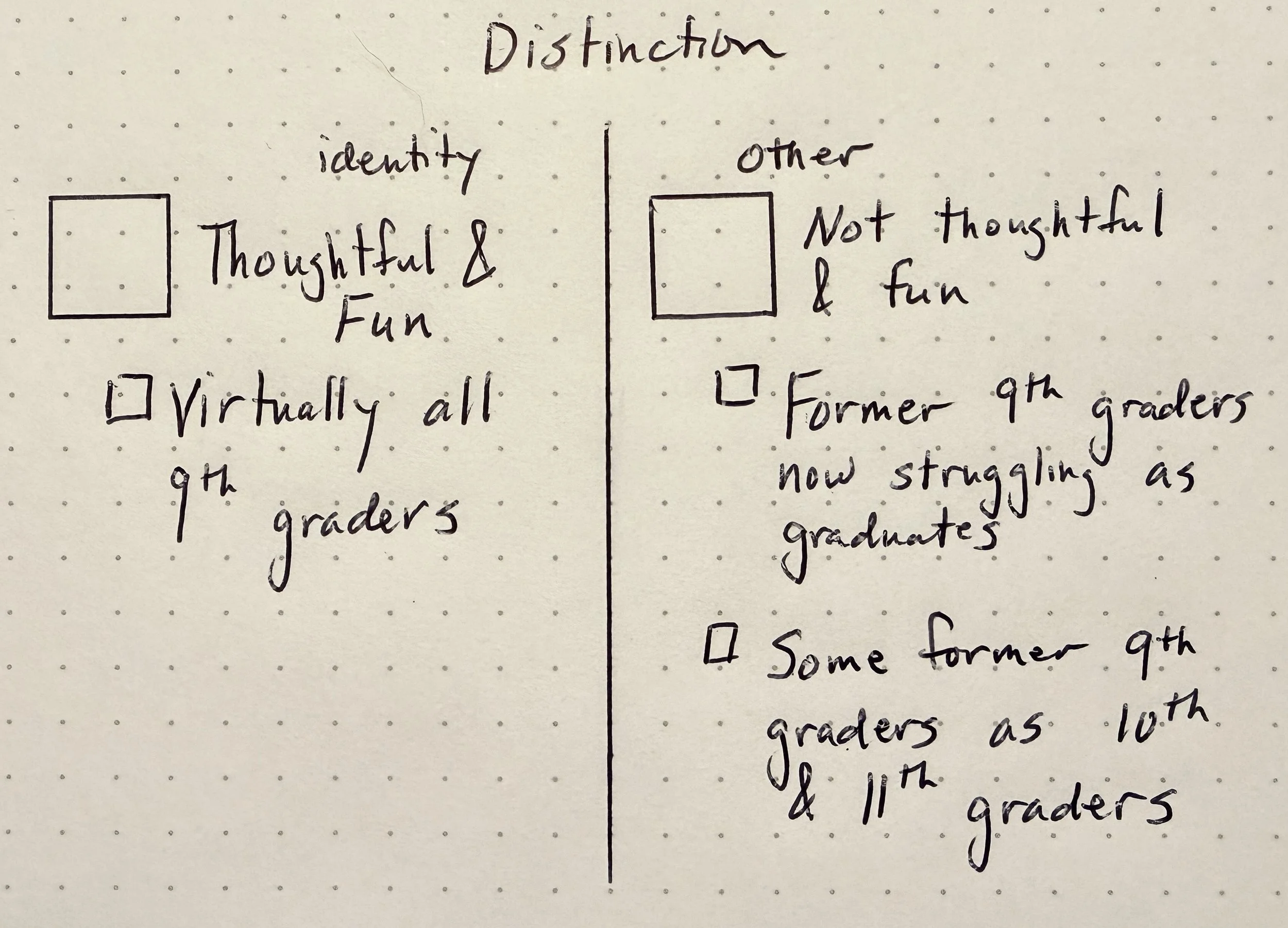
Map 2: I was implicitly aware of this information, though completely unaware that making clear distinctions was a crucial skill. Today, I would reorganize this information into a causal web map (Relationship pattern) and then add points on that view. I’m sticking to this distinction map because it most accurately describes my mental model at the time, and as a distinction it demands serious questioning.
When I brought up these struggling current and former students with colleagues, the response I remember best was, “It’s the culture, there is nothing we can do.” I would’ve adopted this opinion as well had my student teaching mentor not inoculated me for life against this copout. My mentors’s training had instilled in me that something could be done, that every kid can achieve. However my ignorance of the cause of the problem was getting clearer and clearer to me. So early that spring, I made up my mind that the next year would be my last as a teacher. Based on what I could see, schools didn’t work well enough for too many kids. I couldn’t handle it any longer.
Then mid-spring, our principal abruptly resigned and left the job before the school year ended. A committee was formed to select a new principal. I was selected to be on that committee. I remember being invigorated by the hiring process, but still being sure the next year would be my last. Thankfully in a few months, incoming principal David would introduce me to the chasm that exists between an educational leader and a dedicated administrator unable to question the status quo deeply enough.

Map 3: The map above is written to start as a Dio List. I’ve left more space in between to capture the concept chasm. If I was mapping this today, I’d surely map a continuum on leadership as well. From a content perspective, as a coach I’d thought and read about leadership for years so I thought I had some understanding of it. Whatever I did know about leadership from coaching, didn’t transfer to the school setting, that’s for sure.
While I could write volumes on how David’s approach to education impacted my thinking over the following five years, I’m only going to spotlight one episode here. Its events have been ballast for me ever since.
The episode occurred in January of David’s first year at our school. We were heading into mid-term exam week. David asked all teachers to submit copies of their mid-term exams to him. The request upset many faculty members. Their basic sentiment was, “Why do we have to submit copies of our exams? I don’t appreciate my professionalism being questioned.” While I recall feeling some discomfort with the thought of my exams being scrutinized; I also wondered what my discomfort was really about. However, the dissonance I felt about the ineffectiveness of schools, towered over my mild discomfort at having to submit an exam to my boss.
The first faculty meeting after exam week, David took out the stack of paper exams. He used them to frame the work that lay ahead in a way both simple and effective. He started our faculty meeting with the following idea: “Exams took a week to review for, and a week to take. Regular classes basically stopped for two weeks.” He continued, “When we look at these exams we need to see something that merits two weeks worth of student time and effort…These exams need to represent significant learning.”
An intense discussion followed, though I don’t recall ever looking at the exams themselves. Then at the end of the meeting, David clarified our direction as a school. I do not remember his exact words, but I’ll never forget the message. As a learning community, we needed to be able to reliably distinguish transferable thinking and learning from rote compliance, completion and trivia.

Map 4: Sometimes mapping a crisp distinction starts by being explicit with what something is NOT. Being clear about the boundary is kind of like starting a puzzle with the outside edges.
In collaborative endeavors prioritizing a map of both the identity AND other of a crucial distinction is even more critical.
David’s lesson from that meeting continues to resonate loudly in too many schools. When we fail to explicitly distinguish what learning is and is not, students and teachers can lose the ability to reliably choose personal growth over the facade of comfort in traditional ruts. (Not that every traditional practice is a rut.)
David both provided a wayward school with some direction, and restored roots to my hope. He did this by centering a crucial distinction. For me, hope depends on being able to see a way forward. Forward only becomes clear through explicit and precise distinctions. Forward progress then, is as distinct from a circular rut as transferable thinking and learning are from compliance, completion and trivia.
It’s been over 15 years since that January faculty meeting. I wish I could say I’ve been a part of transforming public educational systems since then, but I cannot. I can say I continue to follow where transferable thinking and learning lead me in my work with students, and in life. My hope cheers loudly sometimes. Even when it doesn’t though, my conscience is quiet.
Updates to this mental model
In the last seven years I’ve worked in two school districts where staff regularly referenced Collective Teacher Efficacy (CTE) research. Collective Teacher Efficacy is the shared belief that through collective action, a faculty can positively impact student achievement. Researcher John Hattie’s data identifies CTE as the top influence on student achievement.
Since I mentioned CTE relevant evidence in my example, I’ll expand my mental model of this example with two more maps.
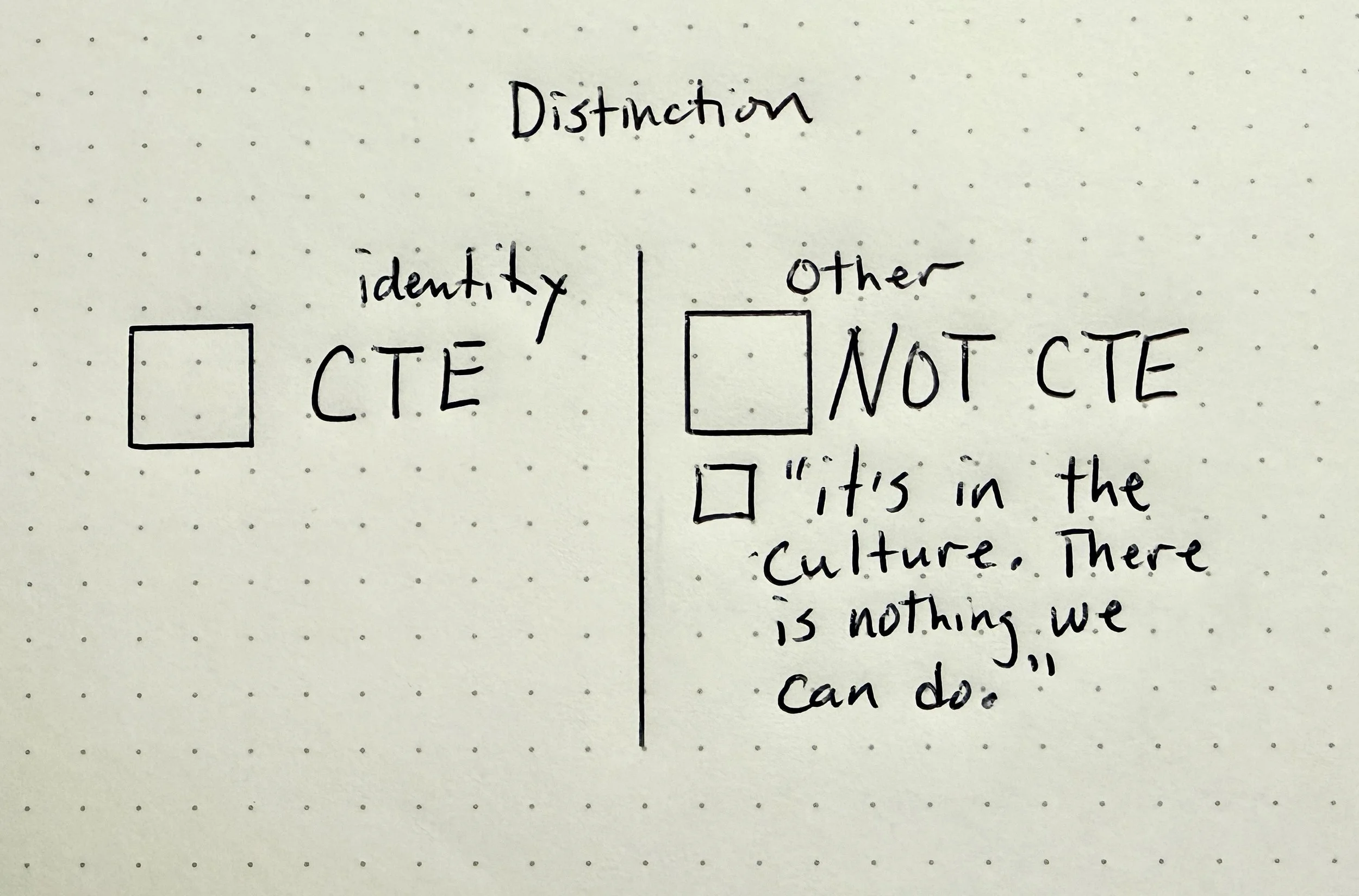
Map 5: Dio List aka Is / Is Not List.
If I want to iteratively increase the accuracy of my mental models, organizing the same information in more than one pattern is an essential DSRP practice.The map below converts information from the previous maps D pattern organization to Perspective pattern.
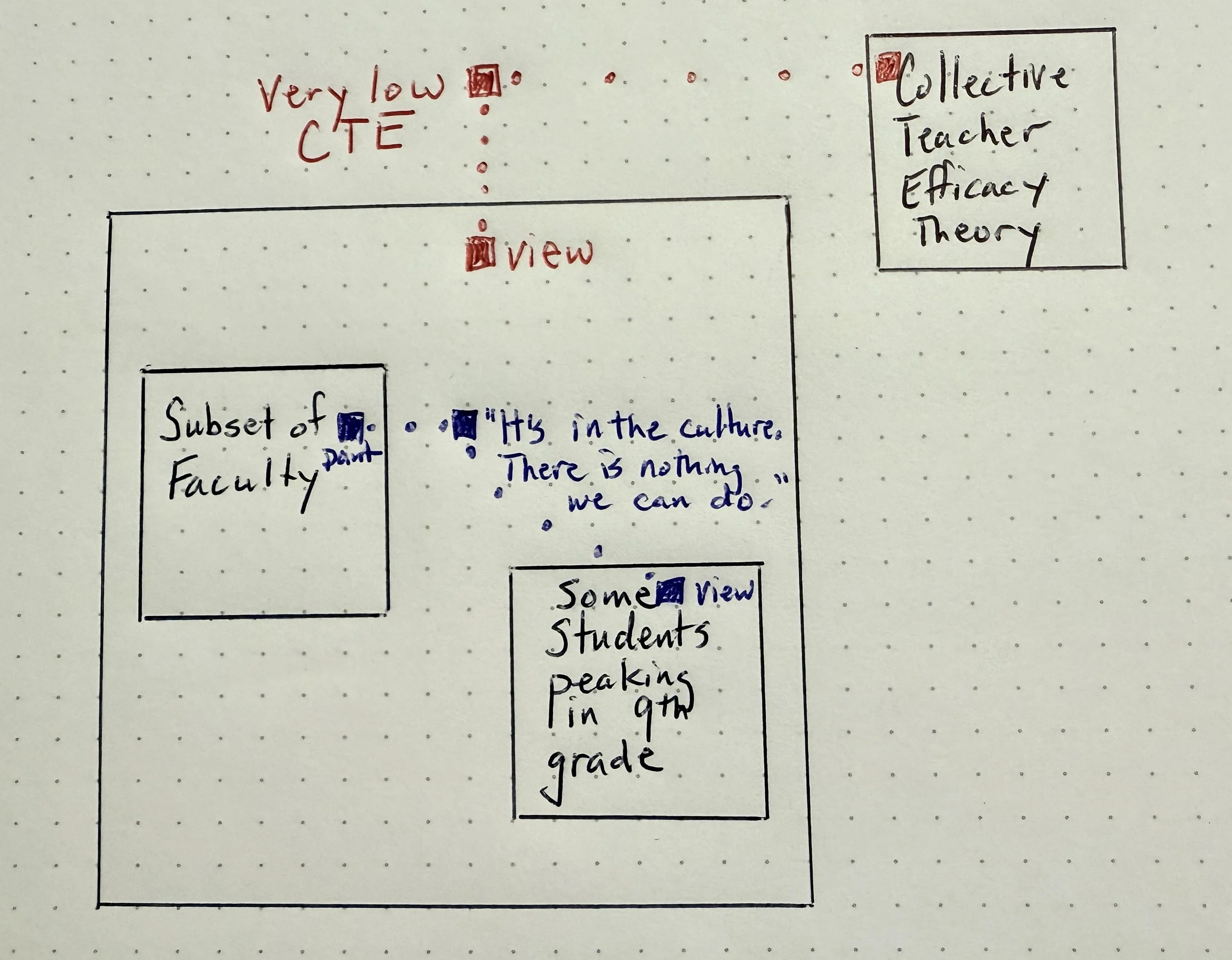
Map 6: A perspective of a perspective. Perspectives are the interaction of a point and a view, so Pvp in this case has more info and structure than the Dio List map above.
I was tempted to add another research model here, but I guess I’ll save it for later. :)
Note: I wasn’t introduced to DSRP until months after the January faculty meeting discussed in this post. My principal David had returned from a conference he attended over break. In the main office one day, he handed me a copy of the book Thinking at Every Desk saying, “I think this is what we’ve both been looking for.”
The next two posts will be shorter. Thanks for hanging in there on this longer one. Until then, I’m rooting for you!
See references page for further reading.